There is a noticeable shift in the room the moment I introduce this unit.
Students lean forward.
Questions start flying.
They want to know what happened — and more importantly, why.
True crime has a way of pulling students in, but what keeps them engaged is not the mystery itself. It is the process of figuring out how a story is built. When students investigate a case, even a fictional one, they begin to understand that journalism is not about rushing to conclusions. It is about asking the right questions, weighing evidence, and telling a story responsibly.
That is why this unit works so well for teaching newswriting.
Why True Crime?
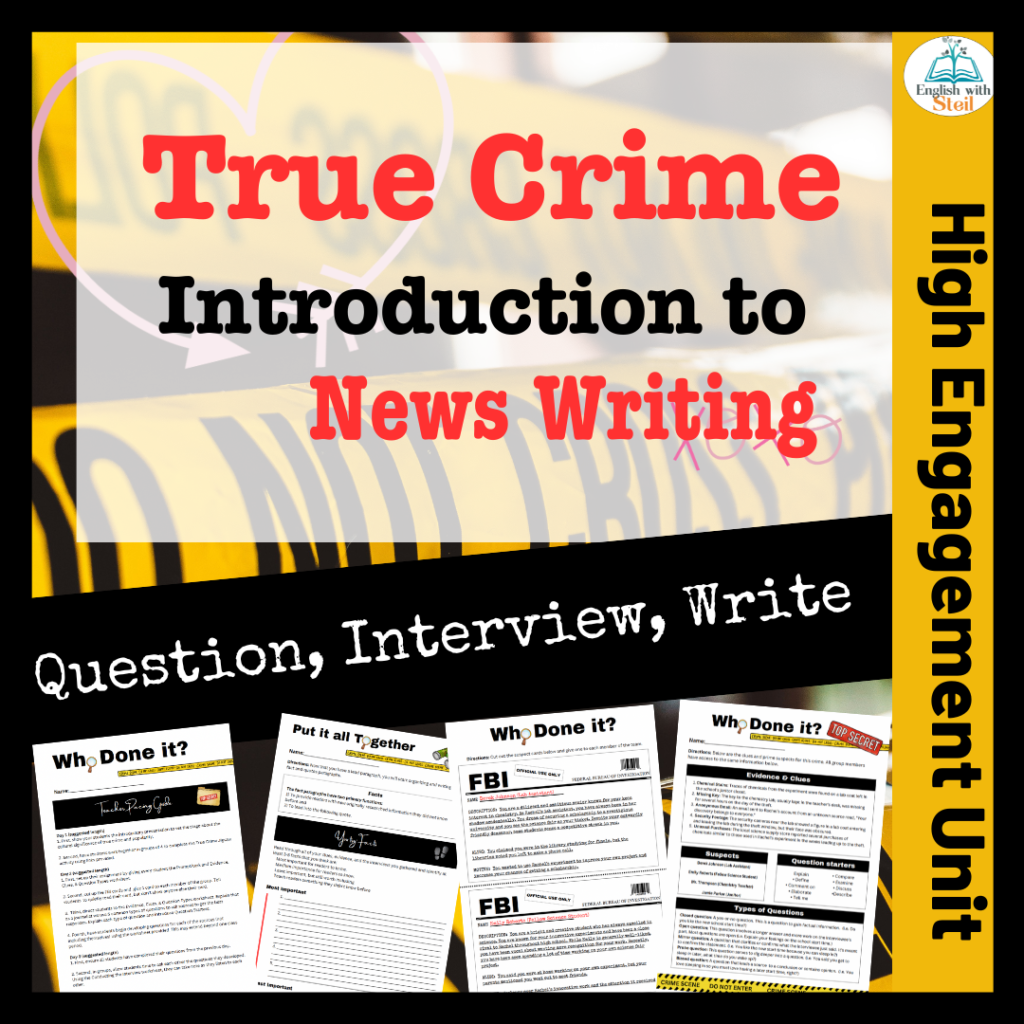
True Crime is a genre that has taken the world by storm, captivating audiences with its blend of mystery, intrigue, and real-life drama. By tapping into this genre, you can engage students in a way that is both exciting and educational. They’ll learn the ins and outs of newswriting while investigating a fictional crime set right in their school!
Why True Crime Works in a Journalism Classroom
True crime is familiar to students. They have seen it in podcasts, documentaries, and social media clips. But what they often do not realize is how much journalism lives underneath those stories.
At its core, true crime relies on the same skills we want students to develop as reporters:
careful research, clear writing, ethical decision-making, and attention to detail.
Using a fictional case gives students the freedom to investigate deeply without the emotional weight of real victims. It creates space for curiosity while still emphasizing responsibility and accuracy.
Why Students Struggle With Newswriting Without a Frame
When students write their first news article, they often try to do everything at once.
They summarize events.
They include every detail they find.
They struggle to decide what matters most.
True crime provides a natural frame. Students have a central question to investigate, a reason to research carefully, and a clear purpose for interviewing and note-taking. The story feels necessary, not assigned.
The Rising Popularity of True Crime
True Crime has seen a significant surge in popularity over recent years, becoming a staple in both entertainment and educational contexts. From podcasts like “Serial” to Netflix series like “Making a Murderer,” the genre has captivated millions with its real-world mysteries and intricate storytelling. This growing interest makes True Crime a powerful tool for engaging students in journalism.
Podcasts: True Crime podcasts have become immensely popular, with shows like “My Favorite Murder” and “Criminal” topping charts and garnering devoted followings. These podcasts offer a deep dive into criminal cases, often featuring interviews with experts and those involved in the cases.
Documentaries and Series: Streaming platforms have embraced True Crime, producing high-quality documentaries and series that explore famous cases and unsolved mysteries. These visual stories provide a rich source of material for students to analyze and learn from.
Books and Articles: The literary world has also seen a boom in True Crime, with bestselling books and investigative articles captivating readers. Works like “In Cold Blood” by Truman Capote and “The Devil in the White City” by Erik Larson offer detailed narratives that combine factual reporting with compelling storytelling.
The fascination with True Crime is not just about the crimes themselves but also about understanding human behavior, societal issues, and the intricacies of the justice system. This makes True Crime an ideal genre for teaching students about the complexities of newswriting and investigative journalism.


A Creative Approach to Investigation and Journalism
This True Crime unit is not just a way to teach writing skills; it’s an innovative method to introduce students to the world of investigation and journalism. Here’s why this approach is so effective:
Engagement through Storytelling: The compelling nature of True Crime stories naturally grabs students’ attention. By involving them in a fictional crime, they become part of the narrative, making the learning process more immersive and enjoyable.
Developing Critical Thinking: Investigating a crime requires students to analyze evidence, ask probing questions, and consider multiple perspectives. These skills are essential in journalism and help students develop a critical mindset.
Real-World Application: The skills students learn in this unit are directly applicable to real-world journalism. From conducting interviews to writing compelling leads, they gain practical experience that prepares them for future endeavors in media and communication.
Collaborative Learning: The unit’s activities encourage collaboration, with students working together to solve the fictional crime. This teamwork fosters communication skills and allows students to learn from each other’s insights and perspectives.
Empathy and Ethics: Discussing True Crime also opens up conversations about ethics in journalism and the importance of empathy when dealing with sensitive subjects. These discussions help students understand the responsibilities that come with being a journalist.
Breaking the Unit Into Investigative Stations
I structure this unit so students move through the reporting process step by step, much like an investigative newsroom.
At the introduction station, students explore what true crime is and why it resonates with audiences. We talk about storytelling versus sensationalism and set expectations for ethical reporting from the start.
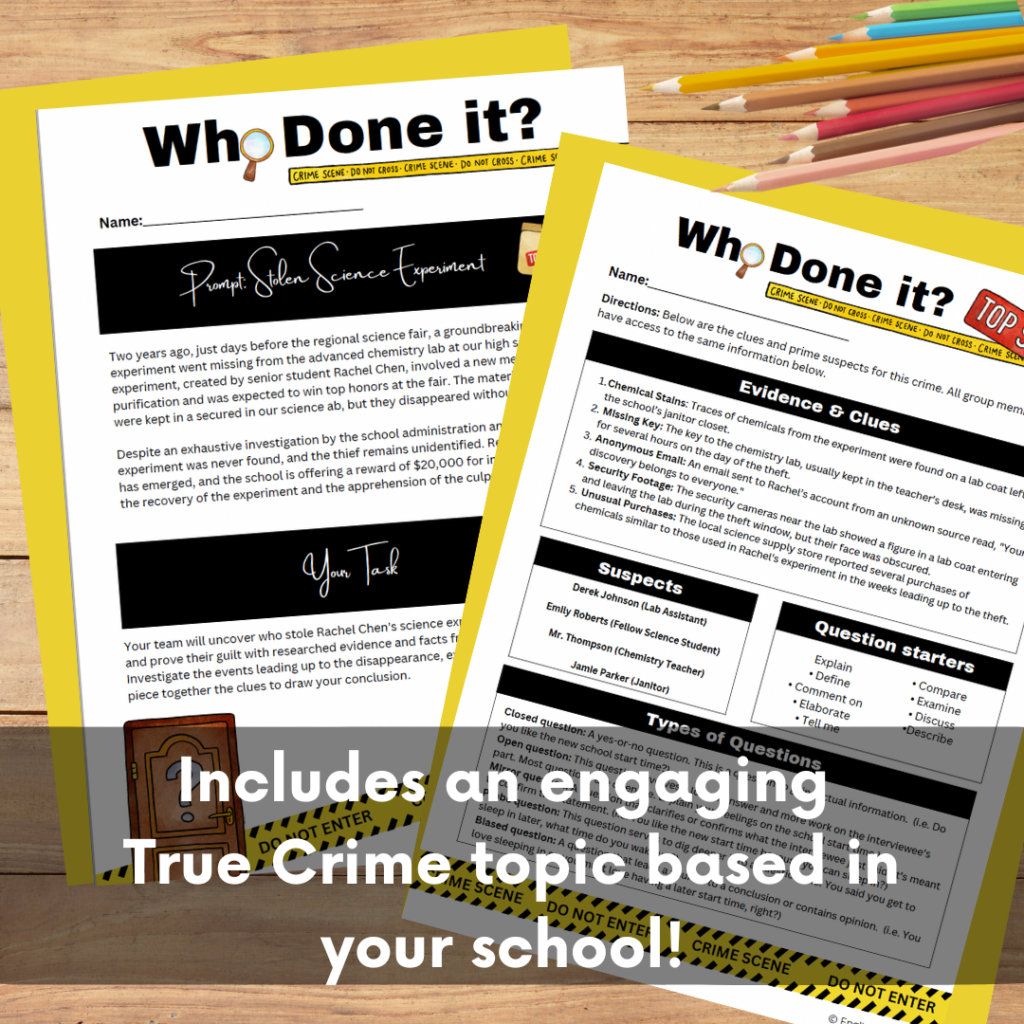
The crime scene station introduces the fictional case. Students receive evidence, background information, and initial details. Their job is not to solve the crime immediately, but to identify what they still need to know.
At the research station, students analyze articles and excerpts from true crime journalism. This helps them notice tone, structure, and how journalists balance fact with narrative.
The suspect analysis station pushes students to slow down. Using fictional suspect cards, they evaluate credibility, motives, and gaps in information. This naturally leads to conversations about bias and assumption.
Interviews, Notes, and Ethical Decisions
The interview station is where students begin to think like journalists. They practice crafting questions, anticipating follow-ups, and recording responses accurately. Students quickly realize that interviews are not about confirmation, but clarity.
At the notes and organization station, students decide what information belongs in their story and what does not. This is often the first time students understand that exclusion is just as important as inclusion in journalism.
Throughout the unit, we return to ethics. Students discuss fairness, language choices, and the responsibility that comes with telling someone else’s story.
Writing the Story With Purpose
Once reporting is complete, students move into drafting.
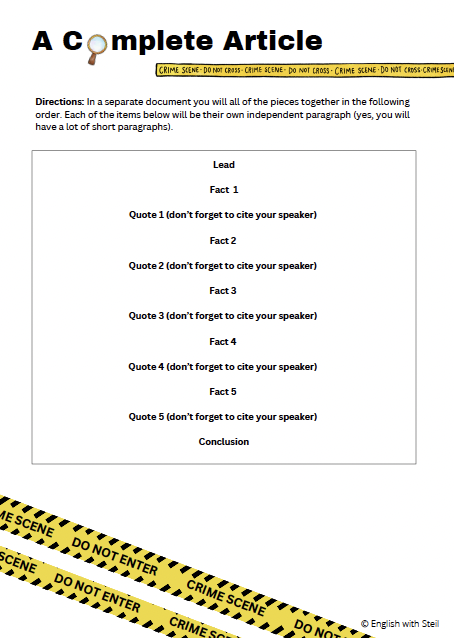
At the lead writing station, they experiment with different types of leads and discuss which best fits the story they are telling.
The body paragraph station focuses on weaving facts and quotes together logically.
The conclusion station emphasizes clarity rather than drama.
Students are not guessing what comes next. They are making decisions based on the reporting they have done.
Why This Approach Works
What changes most is student confidence.
They stop asking if their article is “right” and start asking if it is accurate.
They revise because they see gaps in their reporting, not because they are told to.
They understand that journalism is a process, not a shortcut.
True crime gives students a reason to care, but the structure teaches them how to write.
A Note If You Want to Try This Unit
Before we begin investigating, I like to give students a simple outline to help them track evidence, interviews, and emerging story angles. It keeps the focus on thinking and decision-making instead of scrambling for organization. If you want a ready-to-use version of that outline, I share a short freebie that supports the early planning stage of this unit.
Final Thoughts
True crime is not just engaging. It is instructional.
When students investigate a case, they practice the habits that define strong journalism: curiosity, skepticism, empathy, and care. They learn that stories are built deliberately and that words carry weight.
And that is a lesson that extends far beyond one unit.
Happy teaching.
Want to Explore Journalism Through High-Interest Texts?
If you’re looking for additional ways to engage students in journalism and nonfiction writing, these resources from fellow teacher-authors pair well with a true crime approach. Each one offers practical, classroom-tested ideas for teaching reporting, analysis, and storytelling.
Teaching Journalism With High-Interest Texts by Bespoke ELA
A helpful look at using engaging nonfiction texts to build journalism and analytical writing skills.
How to Teach Media Literacy Through Current Events by Secondary Sara
A practical guide to helping students analyze real-world media while strengthening critical thinking.
Using Nonfiction Narratives to Teach Writing by Laura Randazzo
A reminder that storytelling techniques can strengthen nonfiction writing without sacrificing accuracy.
Engaging Reluctant Writers With Authentic Writing Tasks by The Daring English Teacher
A strong example of how real-world writing tasks increase student buy-in and purpose.