There is a point in every journalism unit when students have ideas but no clear direction.
They know what happened.
They have quotes and notes.
They are ready to write…
…and yet their stories feel scattered.
When that happens, it is usually not a writing problem. It is a planning problem.
Over time, I have learned that students do not struggle because they lack creativity. They struggle because they are trying to make too many decisions at once. Theme, angle, focus, research, interviews, structure — it all collides the moment they open a blank document.
That is why I started teaching these skills as a toolbox, not a checklist.
As teachers, we’re always seeking innovative ways to engage our students, and one of the most dynamic fields we can draw from is journalism. The art of newswriting is not only about conveying information but also about capturing human experiences and emotions.
Why Students Need a Journalism Toolbox
Journalism asks students to make intentional choices.
What is this story really about?
Whose perspective matters most?
What details deserve space on the page?
Without explicit support, students often default to retelling events instead of shaping stories. Slowing the process down and isolating each decision helps students understand that strong journalism is built, not rushed.
Stations make that thinking visible.
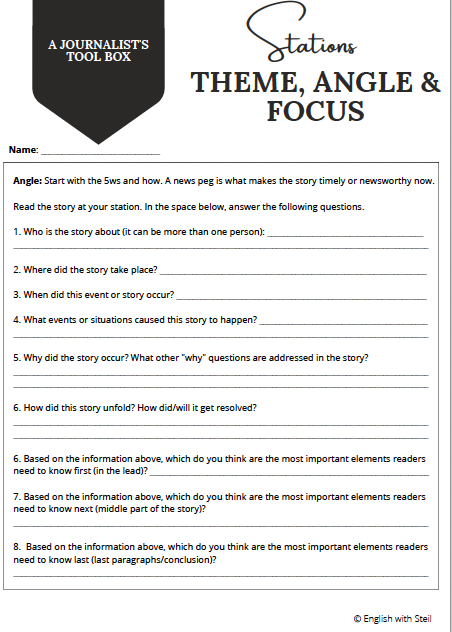
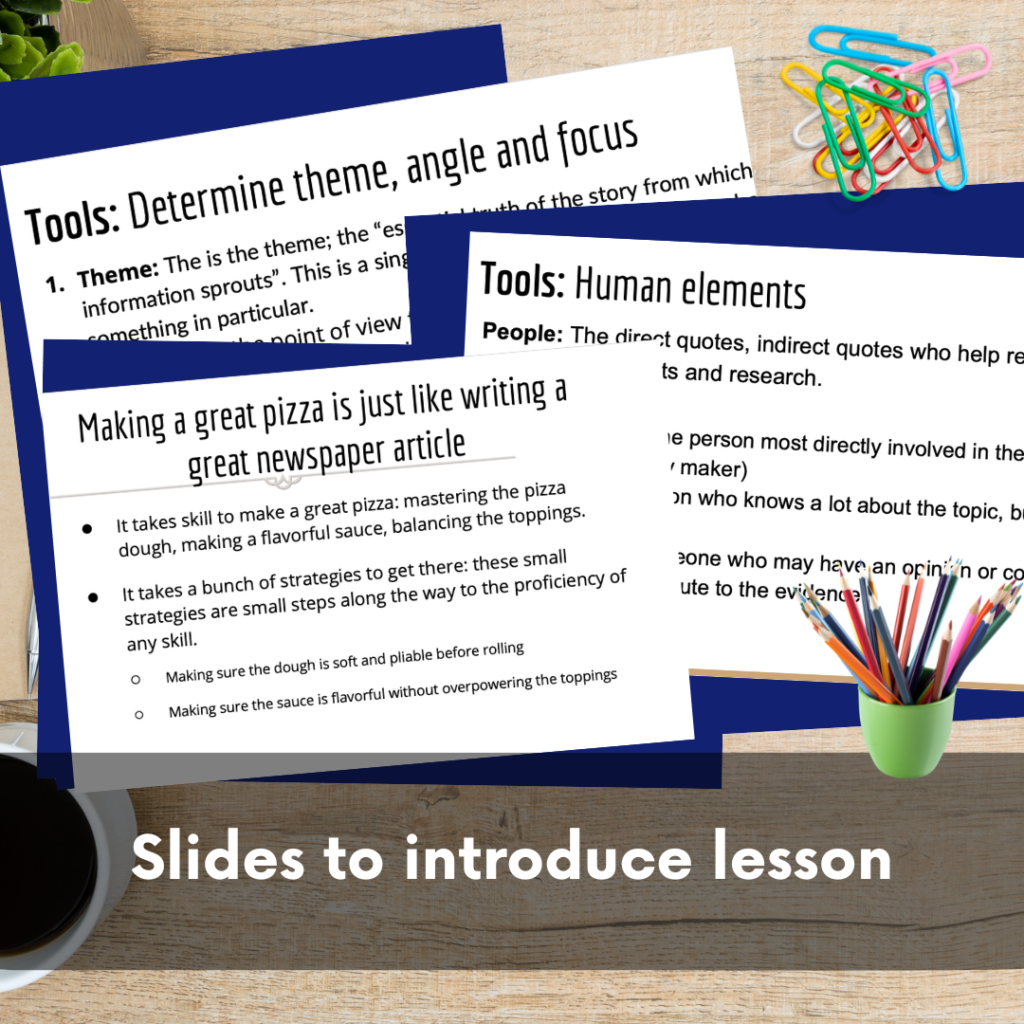
Before we ever start drafting, I like to give students a low-pressure way to think through the decisions journalists make before writing. We talk about theme, angle, and focus using real examples and guided prompts so students can see how stories take shape before they ever open a document. If you want a ready-to-use version of that planning conversation, I share a short freebie that helps students start thinking like journalists from the beginning.
Breaking Down Theme, Angle, and Focus
I start by separating three concepts students often mix together: theme, angle, and focus. Each one gets its own space.
At the theme station, students step back and consider the bigger idea behind a story. They read short examples and talk through what the article is ultimately saying about people, communities, or issues. This station helps students move beyond surface-level reporting.
The angle station asks students to think about perspective. Students examine how the same event can be covered in different ways depending on who is centered and what questions are asked. This is often the moment students realize that journalism is not neutral by default — it is shaped by choices.
At the focus station, students practice narrowing their ideas. Broad topics become specific story paths. This station alone makes a noticeable difference in clarity once students begin drafting.
The Power of Theme, Angle, and Focus
In journalism, the theme, angle, and focus of a story are foundational. These elements guide how a story is told and what makes it compelling. To help my students grasp these concepts, I set up three stations, each dedicated to one of these elements.
Theme Station: Here, students explore the overarching message or subject of a story. They read sample articles and identify the main theme, discussing how it shapes the narrative and the readers’ understanding.
Angle Station: At this station, students learn about the unique perspective or approach taken in a story. They analyze different articles to see how the same event can be reported from various angles, highlighting the importance of viewpoint in journalism.
Focus Station: This station zeroes in on the specific details and aspects of a story. Students practice narrowing down broad themes into focused stories, learning how to maintain clarity and depth in their writing.
Research and Interviews: Giving Stories Depth
Once students have a clear direction, we move into the stations that give stories substance.
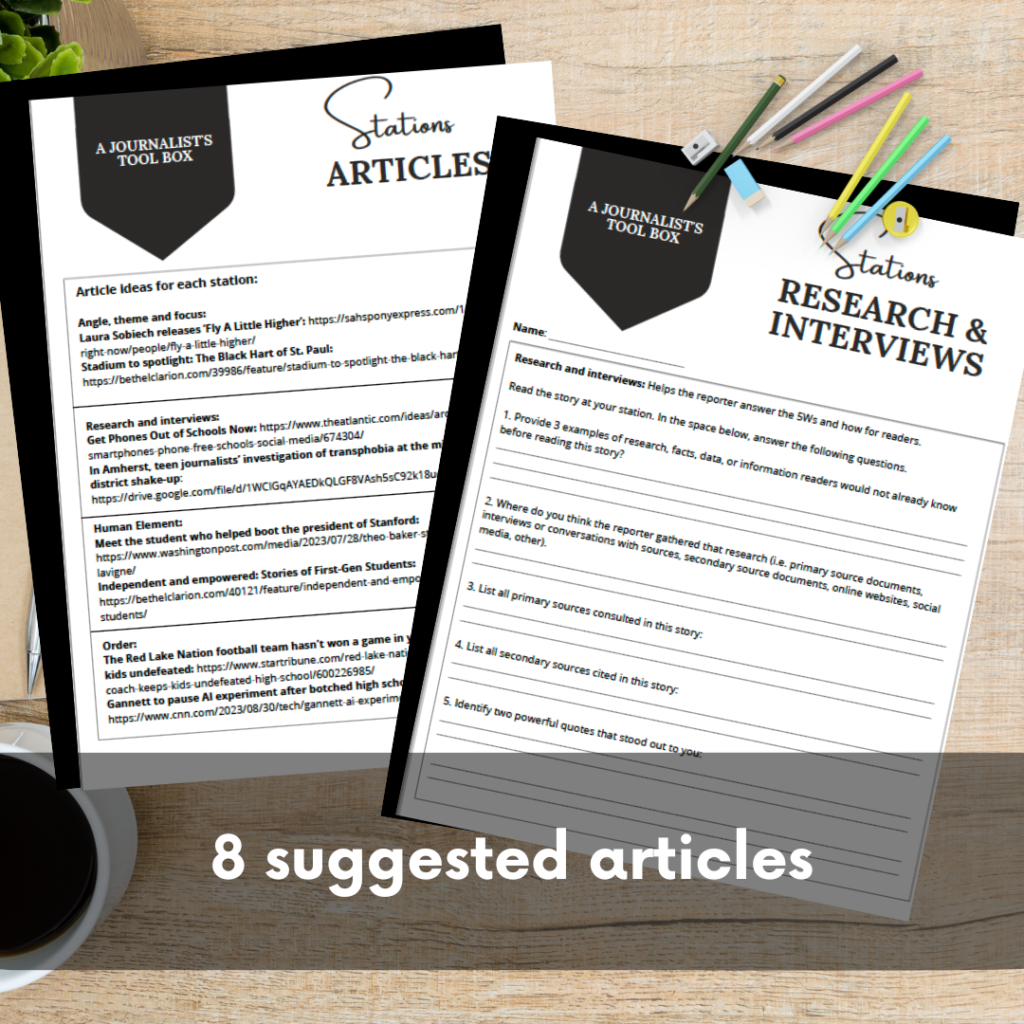
The research station helps students practice evaluating sources and gathering information with purpose. Instead of collecting everything, students decide what information actually supports their angle and focus.
The interview station is always a favorite. Through role-playing, students practice asking open-ended questions, listening carefully, and capturing meaningful quotes. They begin to understand that interviews are conversations, not scripts.
The Human Element: What Makes Stories Stick
This station is where students begin to understand why journalism matters.
At the human element station, students explore how personal stories, emotion, and lived experience bring reporting to life. They analyze excerpts that highlight voice and connection, then practice weaving human detail into their own writing.
This is often where students shift from reporting facts to telling stories readers care about.
Bringing It All Together Through Structure
The final station is where everything connects.
Using notes from each previous station, students begin drafting with intention. They think carefully about how their stories unfold instead of dumping information onto the page.
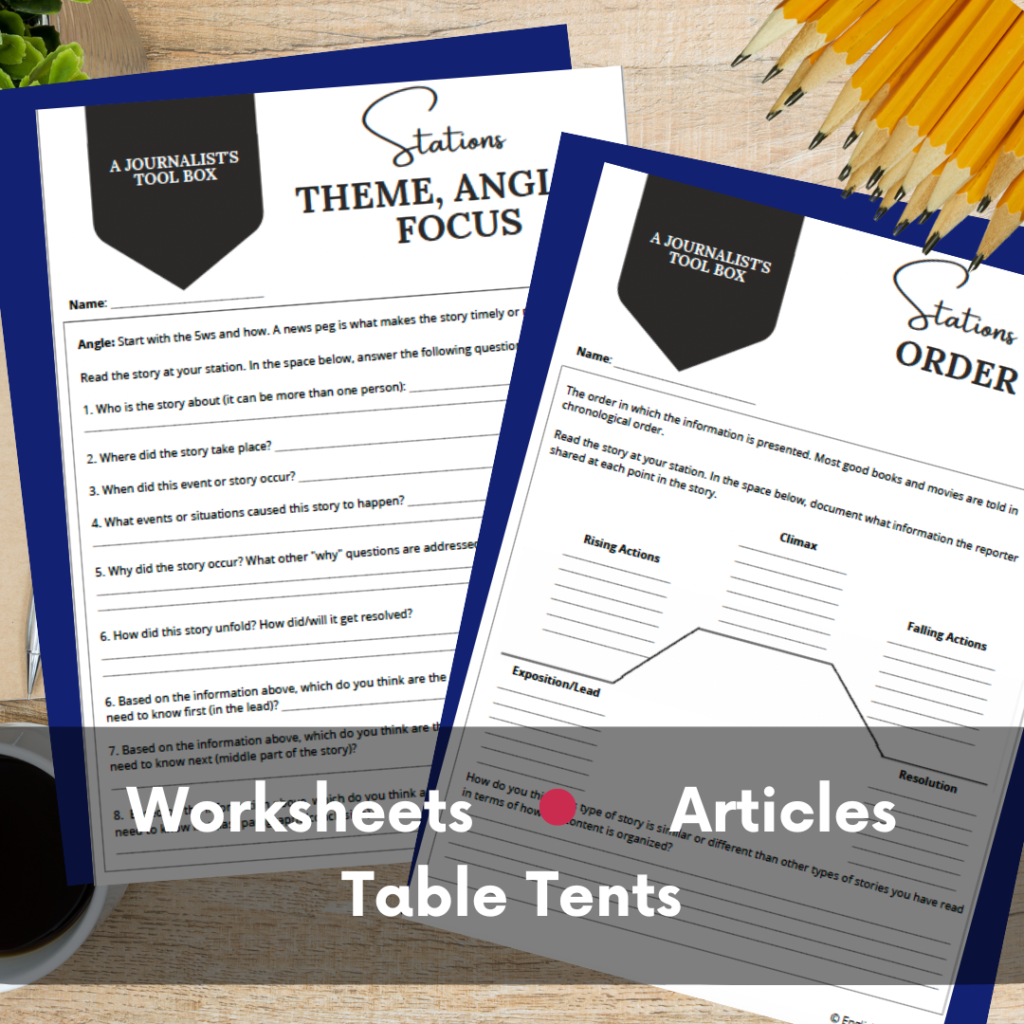
At the order and structure station, students explore the inverted pyramid alongside narrative and chronological structures. They decide which structure best fits their story and explain why. This reinforces the idea that structure is a tool, not a rule.
Why This Approach Works
What I notice most is the confidence shift.
Students stop asking what I want and start asking what their story needs.
They write with clarity because they know their purpose.
They revise with intention because they understand their choices.
Planning becomes part of the craft, not an afterthought.
A Note If You Want to Try This in Your Classroom
If you want support teaching these skills through stations, I use a set of planning tools that guide students through theme, angle, focus, research, interviews, and structure step by step. They are flexible enough to adapt to your classroom and help students focus on thinking rather than guessing what comes next.
Take what works, adjust what you need, and make it your own.
Interactive and Engaging Learning
These stations are not just about learning journalistic techniques—they are about making learning interactive and engaging. By moving through different activities and collaborating with peers, students stay motivated and invested in their learning.
Implementing this method in your classroom can transform the way students understand and appreciate the craft of journalism. It provides them with practical skills, fosters critical thinking, and enhances their ability to communicate effectively. Most importantly, it shows them that every story has the power to inform, inspire, and connect us all.
So, let’s equip our students with the tools they need to become the storytellers of tomorrow. Happy teaching!
Final Thoughts
Journalism is not just about writing quickly. It is about writing thoughtfully.
When students learn to use a journalist’s toolbox, they begin to see storytelling as a series of intentional decisions. And once they understand that, their writing becomes clearer, more purposeful, and more human.
When students understand the tools journalists use to shape stories, they stop guessing and start writing with purpose. Teaching the toolbox gives students clarity, confidence, and a deeper respect for the craft of storytelling.
Happy teaching.
Looking for More Ways to Teach Journalism Skills?
If you’re building a journalism unit or refining how you teach story planning, these resources from fellow teacher-authors pair well with this approach. Each one offers practical, classroom-tested strategies for teaching writing, media, and storytelling.
Journalism Jumpstart: Teaching News Writing Basics by Bespoke ELA
A helpful foundation for introducing journalism concepts, story structure, and ethical decision-making.
How to Teach Media Literacy in ELA by Secondary Sara
A clear, student-friendly approach to helping students evaluate sources, bias, and credibility.
Teaching Visual Literacy and Media Analysis by Laura Randazzo
A strong reminder that images, layout, and design are essential texts worth close analysis.
Using Real-World Texts to Teach Writing by The Daring English Teacher
A smart example of how authentic texts help students write with purpose and clarity.