
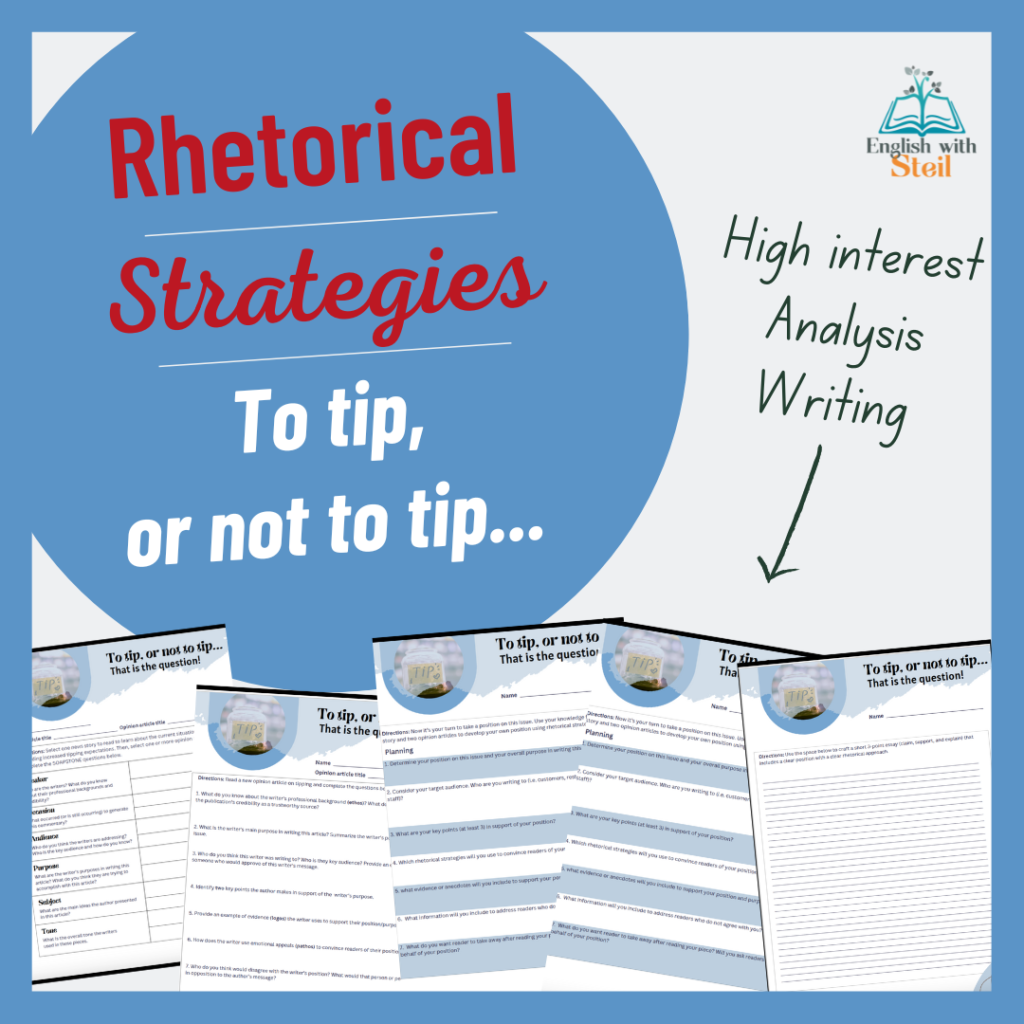
Are you looking for a way to make rhetoric come alive for your students? Using current, high-interest topics from the news media can do just that! Through the study of rhetorical strategies—ethos, pathos, and logos—students will read and analyze articles on the debate of whether to tip or not. This engaging unit will help them think critically, evaluate different viewpoints, and develop their own informed opinions.
Every year, I reach the part of the curriculum where rhetoric comes up, and I can almost feel students brace themselves. Ethos, pathos, logos sound abstract on paper, and if I am not careful, the lesson can quickly turn into students hunting for labels instead of actually thinking about persuasion.
What finally changed the energy in my classroom was anchoring rhetoric to a question students already had opinions about. The tipping debate did exactly that. Suddenly, rhetoric was not something we were “learning about.” It was something students were actively using to make sense of a real argument happening in the world around them.
Why the Tipping Debate Works So Well for Teaching Rhetoric
Students do not need convincing that tipping is relevant. Many of them work service jobs, have family members who do, or have strong feelings about tipping culture themselves. That personal connection matters. When students care about the topic, they naturally engage more deeply with how arguments are constructed.
Using tipping as the anchor allowed rhetoric to feel practical instead of academic. Students could immediately see how credibility, emotion, and logic showed up in real articles they might scroll past online. Instead of asking, “What is ethos?” they began asking, “Why does this author feel more trustworthy?” That shift makes all the difference.
Introducing Ethos, Pathos, and Logos in a Way That Sticks
I still introduce ethos, pathos, and logos directly, but I no longer treat them as vocabulary students must memorize. Instead, I frame them as tools writers use intentionally depending on their audience and purpose.
A short presentation helps establish shared language, but the real understanding comes when students see these strategies in action. Pairing rhetorical appeals with SOAPSTONE gives students a clear structure for thinking about why an author made certain choices. It also helps them move beyond surface-level identification and toward analysis.
At this stage, we look at real excerpts from articles about tipping and talk through what stands out. Students start noticing patterns on their own, which signals they are ready to dig deeper.
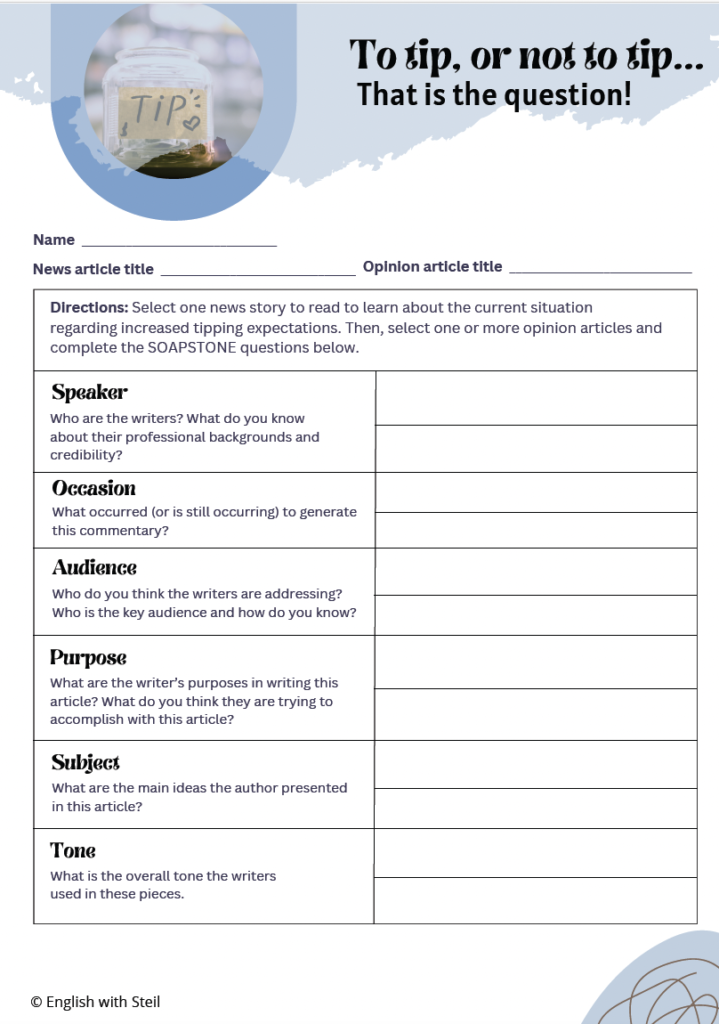
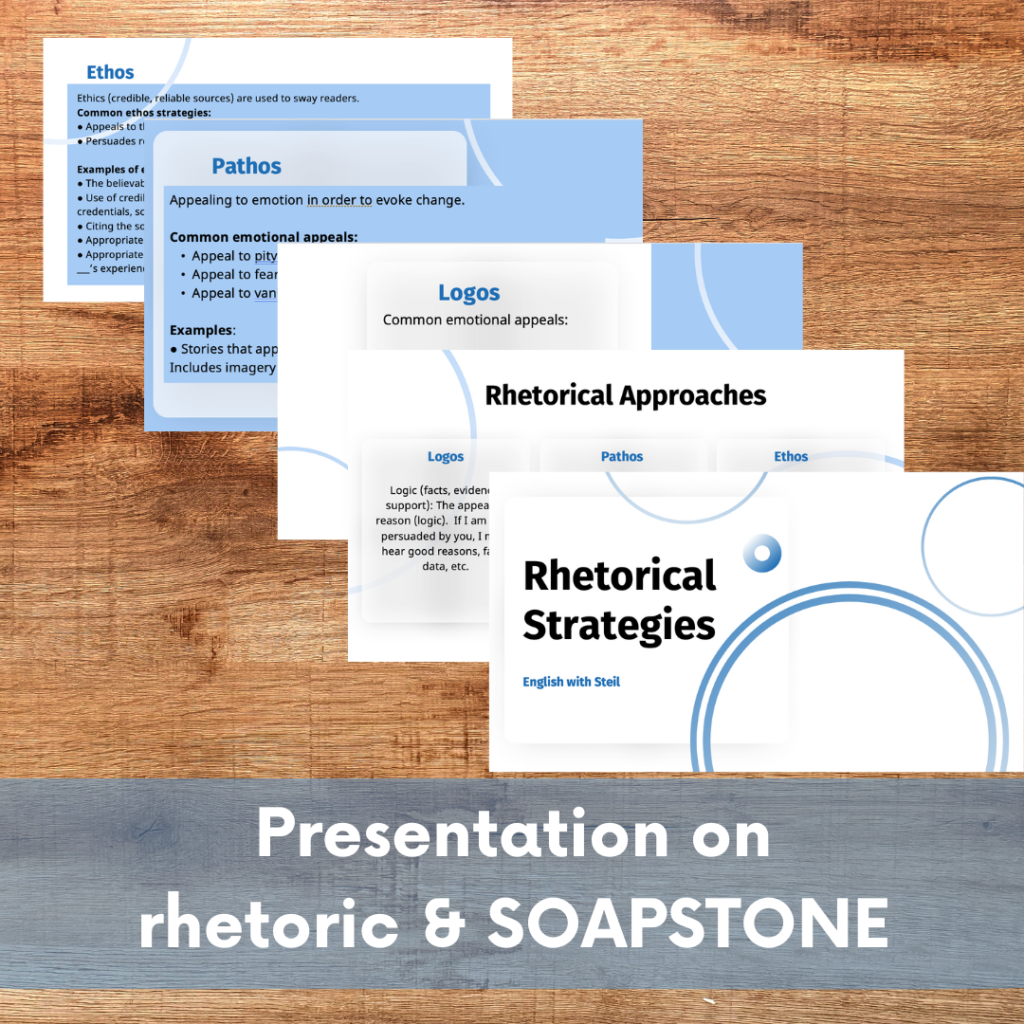
Presentation on Rhetorical Strategies: Kick off the unit with a 5-slide presentation that breaks down ethos (credibility), pathos (emotional appeal), and logos (logical reasoning). Incorporate the SOAPSTONE method (Speaker, Occasion, Audience, Purpose, Subject, Tone) to help students analyze rhetorical situations comprehensively.
How-To Tip: Use real-world examples from popular media to illustrate each rhetorical strategy. This makes the concepts more accessible and engaging for students.
Reading and Analyzing Articles
Diverse Perspectives: Provide students with a selection of nine hyperlinked articles that cover both sides of the tipping debate. Include a mix of news reports and opinion pieces to give a well-rounded view of the issue. Make sure the articles are up-to-date and come from credible sources.
Close Reading: Use a 2-page worksheet to guide students through a close reading of the articles. The worksheet prompts them to identify the rhetorical strategies used by the authors and analyze their effectiveness. This exercise not only deepens their understanding of rhetoric but also enhances their critical thinking skills.
How-To Tip: Encourage students to highlight and annotate the articles as they read. This active reading strategy helps them engage more deeply with the text and identify key rhetorical elements.

Reading Real Articles With Real Stakes
Once students have the rhetorical framework, we move into close reading. Instead of relying on a single text, I provide multiple articles that represent different perspectives on tipping. This variety is essential. It shows students that rhetoric shifts depending on purpose, audience, and stance.
Students use guided questions to analyze how each author builds their argument, where emotional appeals appear, and how evidence is used. Annotating becomes more purposeful because students are looking for strategy, not just summary. Discussions at this point are often lively because students are not just analyzing rhetoric. They are reacting to it.
What I appreciate most is that students begin to recognize persuasion as something intentional rather than accidental. That awareness carries over into their own writing.
Moving From Analysis to Opinion Writing
After students have examined how others make arguments, they are ready to develop their own positions. This step feels far less intimidating because students already have models in front of them. They have seen what works and what feels weak.
Using a structured planning process helps students organize their ideas before writing. Instead of jumping straight into an essay, they think carefully about their claim, their evidence, and which rhetorical strategies best support their stance. This planning stage improves the quality of their writing significantly.
Peer review becomes especially powerful here. Students are not just commenting on grammar. They are discussing rhetorical choices and effectiveness, which deepens their understanding even further.
Flexibility That Actually Matters in the Classroom
One of the reasons this lesson has stayed in my rotation is its flexibility. Some years, I stretch it into a full rhetoric unit with multiple days of reading, discussion, and writing. Other times, I condense it into a shorter lesson when time is tight.
It also works well for sub plans or days when you need a structured but engaging activity that students can handle independently. Everything builds logically, so students are not lost even if the pacing shifts.
That adaptability makes it a reliable option during busy stretches of the school year.
Reading Real Articles With Real Stakes
Once students have the rhetorical framework, we move into close reading. Instead of relying on a single text, I provide multiple articles that represent different perspectives on tipping. This variety is essential. It shows students that rhetoric shifts depending on purpose, audience, and stance.
Students use guided questions to analyze how each author builds their argument, where emotional appeals appear, and how evidence is used. Annotating becomes more purposeful because students are looking for strategy, not just summary. Discussions at this point are often lively because students are not just analyzing rhetoric. They are reacting to it.
What I appreciate most is that students begin to recognize persuasion as something intentional rather than accidental. That awareness carries over into their own writing.
Moving From Analysis to Opinion Writing
After students have examined how others make arguments, they are ready to develop their own positions. This step feels far less intimidating because students already have models in front of them. They have seen what works and what feels weak.
Using a structured planning process helps students organize their ideas before writing. Instead of jumping straight into an essay, they think carefully about their claim, their evidence, and which rhetorical strategies best support their stance. This planning stage improves the quality of their writing significantly.
Peer review becomes especially powerful here. Students are not just commenting on grammar. They are discussing rhetorical choices and effectiveness, which deepens their understanding even further.
Flexibility That Actually Matters in the Classroom
One of the reasons this lesson has stayed in my rotation is its flexibility. Some years, I stretch it into a full rhetoric unit with multiple days of reading, discussion, and writing. Other times, I condense it into a shorter lesson when time is tight.
It also works well for sub plans or days when you need a structured but engaging activity that students can handle independently. Everything builds logically, so students are not lost even if the pacing shifts.
That adaptability makes it a reliable option during busy stretches of the school year.
Developing and Writing Their Own Opinions
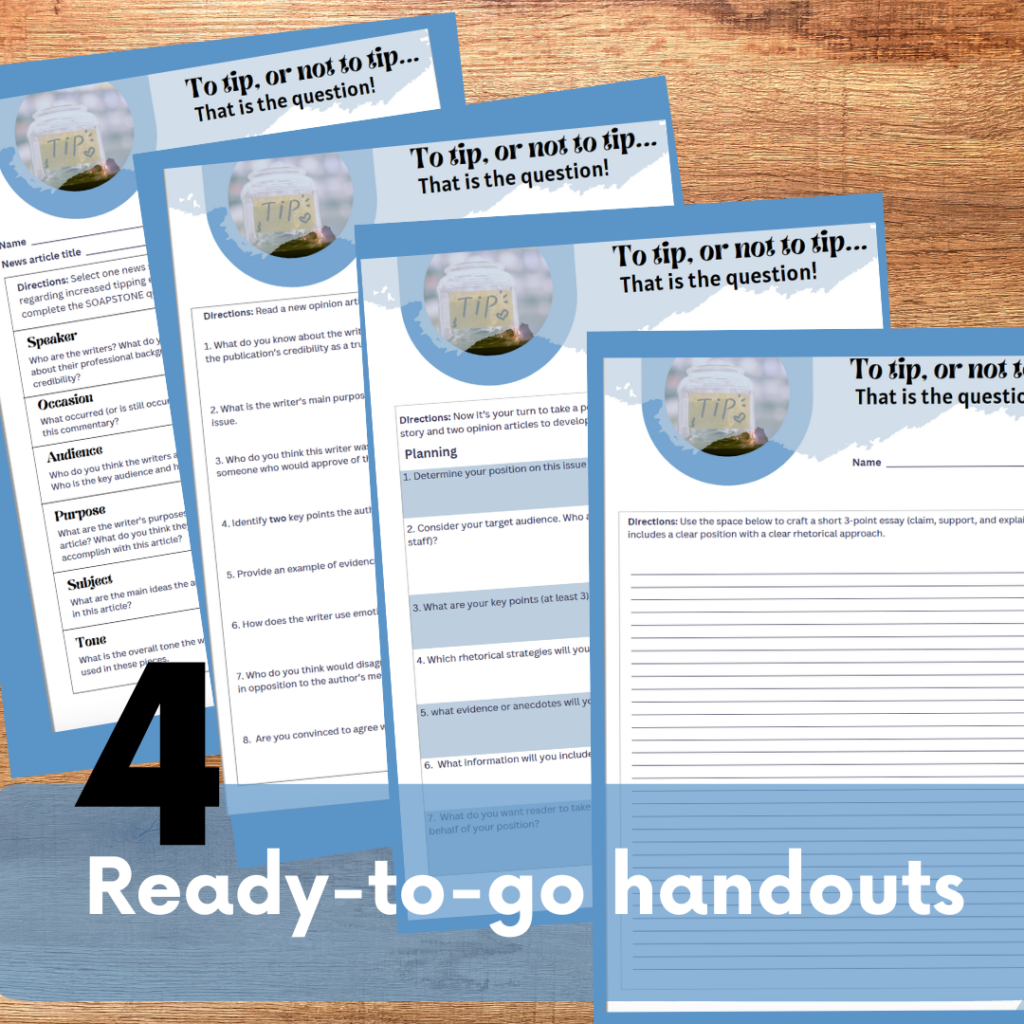
Formulating Opinions: After analyzing the articles, students will use a second 2-page worksheet to develop their own positions on the tipping debate. The worksheet guides them through organizing their thoughts, gathering evidence, and structuring their arguments.
Opinion Writing Template: Provide a template for students to write their own opinion pieces. This template helps them apply the rhetorical strategies they’ve learned and ensures their writing is clear, persuasive, and well-organized.
How-To Tip: Have students peer-review each other’s opinion pieces. This not only improves their writing through feedback but also exposes them to different perspectives and argumentative styles.
Flexible Lesson Plans
This resource is incredibly versatile. You can stretch it out into a multi-day lesson on rhetoric or break it down into single-day lessons if you’re short on time. It’s also perfect for substitute teachers, as it includes everything needed for a comprehensive and engaging lesson.
Multi-Day Lesson Plan:
- Day 1: Introduce ethos, pathos, logos, and SOAPSTONE with the presentation.
- Day 2: Begin close reading of articles with guided worksheet.
- Day 3: Continue article analysis and class discussion.
- Day 4: Develop personal opinions using the second worksheet.
- Day 5: Write and peer-review opinion pieces.
Single-Day Lesson Plan: If you need a quicker option, focus on one article and a specific rhetorical strategy. Have students analyze the article and write a brief response using the identified strategy.
Check Out These Resources from My Fellow Teacher Authors
If you are looking to expand your rhetoric unit or add more real-world argument analysis, these teacher-created resources pair perfectly with teaching ethos, pathos, and logos through current events.
Rhetoric, Argument, and Persuasion
Secondary Sara
How to Teach Rhetorical Appeals Without the Eye Glaze
This post offers practical strategies for helping students move beyond labeling ethos, pathos, and logos and actually analyze how persuasion works.
The Daring English Teacher
How to Teach Ethos, Pathos, and Logos Using Real-World Examples
A great companion for using current events and modern debates to make rhetorical appeals feel relevant and concrete for students.
What Students Walk Away With
By the end of this lesson, students are not just able to define ethos, pathos, and logos. They understand how rhetoric functions in real conversations that affect people’s lives. They see how arguments are shaped, whose voices are amplified, and why certain messages persuade more effectively than others.
Perhaps most importantly, students start to see themselves as participants in public discourse rather than passive consumers of opinions. That awareness is one of the most valuable outcomes of teaching rhetoric well.
Final Thoughts
Rhetoric does not need to feel abstract or disconnected from students’ lives. When it is grounded in real issues students care about, it becomes one of the most engaging parts of the curriculum.
Using the tipping debate allows students to practice critical reading, thoughtful analysis, and persuasive writing in a context that feels authentic. The result is deeper learning, stronger writing, and conversations that matter.

