
Why Editorial Cartoons?
Editorial cartoons are one of those tools that feel deceptively simple.
It is “just a picture,” right?
Until students actually try to explain what the cartoon is saying, how it is saying it, and who it is trying to persuade. That is when the thinking gets deep fast.
I started using editorial cartoons when I wanted a way to teach persuasion and media literacy without defaulting to another article analysis or essay. What I discovered is that editorial cartoons slow students down in the best possible way. They force students to read images carefully, question intent, and justify interpretation.
And best of all, they work across journalism, ELA, social studies, and current events.
Editorial cartoons are powerful educational tools. They combine art and journalism to convey messages about current events and social issues, often using humor and satire. By exploring these cartoons, students can develop critical thinking, visual literacy, and an understanding of persuasive techniques. This unit provides a structured yet engaging way for students to delve into the world of editorial cartoons.
Editorial cartoons offer a dynamic and interactive approach to teaching persuasive techniques, visual literacy, and critical thinking. This hands-on unit plan provides everything you need to help students read, analyze, and create editorial cartoons while building a wide array of skills.
Why Editorial Cartoons Work So Well in the Classroom
Editorial cartoons sit at the intersection of art, argument, and journalism. They compress an opinion into a single frame, which makes them perfect for teaching analysis without overwhelming students.
When students analyze cartoons, they have to:
Identify a claim without being told what it is
Interpret symbols and exaggeration
Consider audience and bias
Connect visuals to real-world context
That combination builds visual literacy and critical thinking at the same time.
How I Introduce Editorial Cartoons (Without Overexplaining)
I do not start with definitions.
I start with observation.
I project a cartoon and ask students three simple questions:
What do you notice first?
What details feel intentional?
What do you think the cartoonist wants you to believe?
Only after students struggle a bit do we name the tools cartoonists use. This keeps the lesson inquiry-based instead of lecture-heavy.
Editorial cartoons are much more than just humorous drawings; they’re a powerful blend of art and journalism that communicate complex ideas through satire, symbolism, and wit. By engaging with these cartoons, students can:
Develop Critical Thinking
Analyzing editorial cartoons requires students to identify the underlying message, evaluate the effectiveness of persuasive techniques, and consider the context of current events. This process sharpens their ability to assess information critically and form reasoned opinions.
Enhance Visual Literacy
In a world dominated by visual media, understanding how images communicate messages is essential. Editorial cartoons teach students to interpret symbolism, recognize caricature, and analyze composition—skills that transfer to other visual texts, including advertisements and infographics.
Build Persuasive and Rhetorical Skills
Editorial cartoons often employ rhetorical devices such as irony, analogy, and hyperbole. By studying these techniques, students learn how to craft persuasive arguments, both visually and verbally, enhancing their ability to communicate effectively.
Express Creativity
Designing their own editorial cartoons allows students to merge creativity with critical thought. They gain the confidence to articulate their views on important issues while exploring artistic expression.
Strengthen Media Literacy
In analyzing editorial cartoons, students learn to question sources, identify biases, and evaluate how media influences public perception. These skills are crucial for navigating today’s complex information landscape.
Teaching Students How to Read Editorial Cartoons
Once students are hooked, I explicitly teach the visual and rhetorical moves cartoonists rely on most.
Here is how I break it down.
Step 1: Teach Visual Techniques One at a Time
Instead of overwhelming students, I introduce techniques in small chunks:
Symbolism
Exaggeration
Labels
Caricature
Irony
Analogy
We look at examples and ask, “What work is this technique doing?” rather than “What is this called?”
Step 2: Model a Think-Aloud
I analyze one cartoon out loud, narrating my thinking:
What clues tell me the topic?
What assumptions does the cartoonist make about the audience?
What emotion is the cartoon trying to provoke?
Students hear how interpretation works, not just the final answer.
Step 3: Guided Practice With Structure
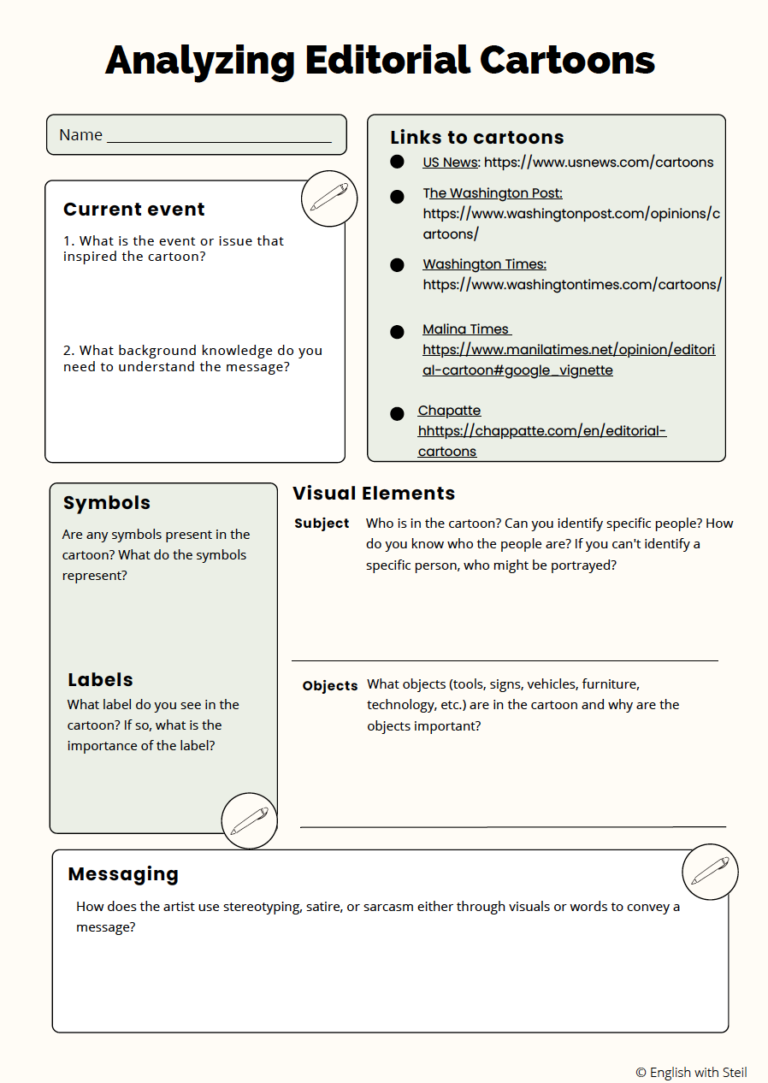
Students then analyze cartoons using structured prompts that require them to:
Identify the issue
Explain the visual choices
Connect technique to message
Evaluate effectiveness
This keeps analysis focused and prevents surface-level responses.
Students Will Love It
Teaching about editorial cartoons is interactive and engaging, making learning fun. By working with editorial cartoons, students can:
- Develop Critical Thinking: Analyzing the cartoons helps students think critically about current events and the messages behind them.
- Enhance Visual Literacy: Understanding the visual elements of cartoons improves students’ ability to interpret and create visual media.
- Express Creativity: Designing their own cartoons allows students to express their thoughts and opinions creatively.
Moving From Analysis to Creation (Where Engagement Explodes)
Once students understand how editorial cartoons work, they are ready to create their own.
This is where confidence builds.
I guide students through the process step by step so creativity does not turn into frustration.
Step 1: Choose an Issue That Actually Matters
Students select a current issue they already have an opinion about. This keeps the focus on message first, art second.
Step 2: Match Message to Technique
Students decide which technique best fits their idea. For example:
Exaggeration for absurd policies
Symbolism for complex systems
Irony for contradictions
This step prevents random drawing.
Step 3: Plan Before Drawing
Students sketch rough ideas and label their symbolism before creating a final version. This makes their thinking visible and intentional.
Step 4: Create With Constraints
Providing a template helps reluctant artists focus on communication rather than perfection.
Full Editorial Cartoon Unit Plan
Full Editorial Cartoon Unit Plan
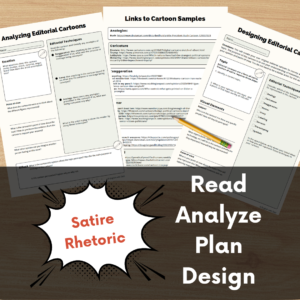
This comprehensive unit is divided into two parts: analysis and creation. Each section is packed with resources to guide your students from understanding professional editorial cartoons to designing their own.
Part 1: Editorial Cartoon Analysis
The first phase of the unit introduces students to the foundational elements of editorial cartoons and the techniques cartoonists use to convey their messages. Here’s what’s included:
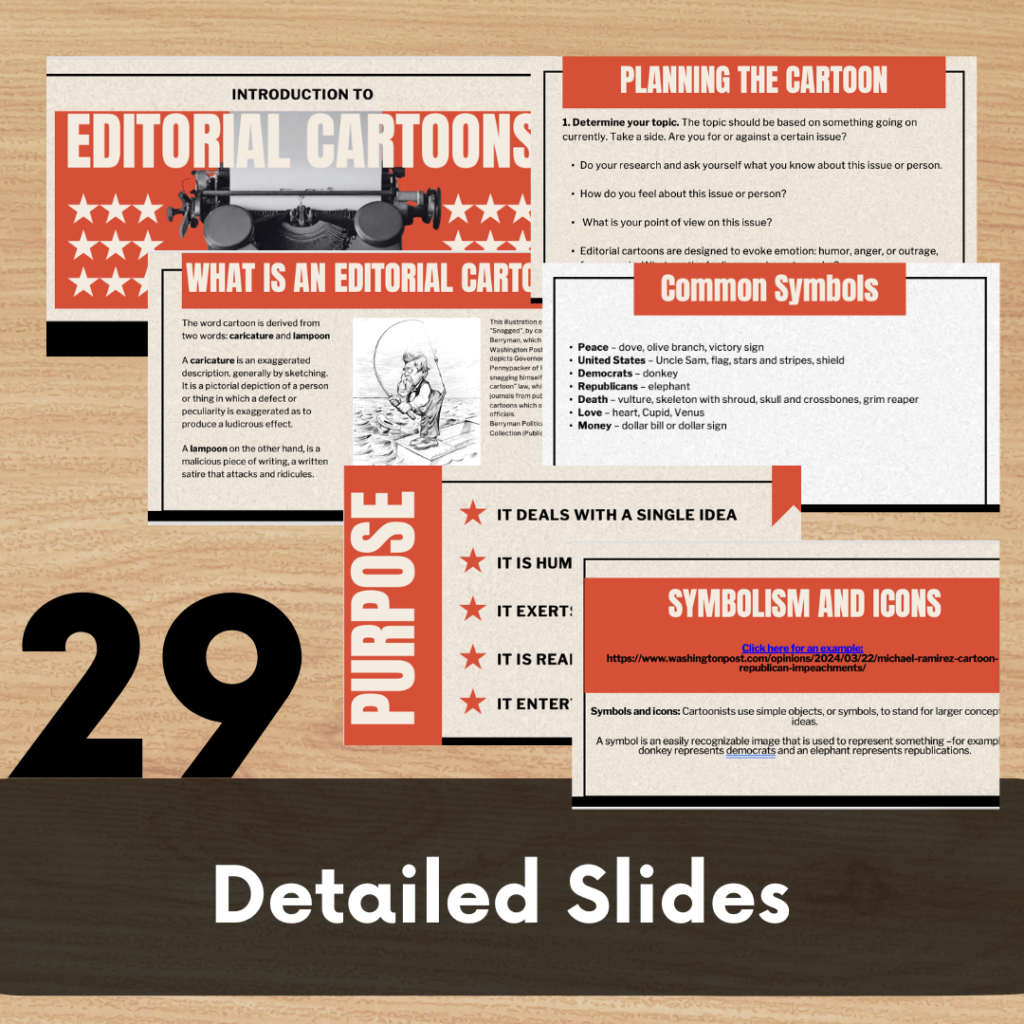
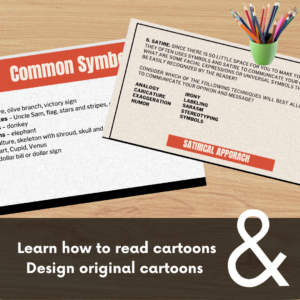
A Comprehensive Slide Deck: This engaging presentation defines key persuasive techniques—symbols, caricatures, exaggeration, labels, irony, analogy, and stereotyping—with examples from current editorial cartoons. The slide deck sets the stage for deep analysis and class discussion with samples.
Analysis Worksheet: Students use this worksheet to analyze professional editorial cartoons. Guided prompts help them identify visual and rhetorical devices, understand the cartoonist’s message, and evaluate its effectiveness. With over 30 linked examples, students have ample opportunities to explore diverse styles and topics.
Rhetorical Devices Focus: In this section, students learn how editorial cartoonists use rhetorical techniques to persuade their audience. Activities guide them to identify irony, pathos, and other devices, fostering a deeper understanding of how visual and textual elements work together.
Skills Students Build in This Phase
Critical Analysis: Breaking down the elements of cartoons teaches students to think analytically about both visual and written texts.
Cultural Awareness: Exploring current events through editorial cartoons helps students understand global and local issues.
Rhetorical Understanding: Recognizing and analyzing rhetorical devices equips students with tools for crafting their own persuasive messages.
Part 2: Design and Create Editorial Cartoons
Once students have a solid understanding of how editorial cartoons work, they’re ready to create their own. This phase focuses on guiding them through the creative process.
Step-by-Step Slide Deck: This presentation outlines six clear steps for designing an editorial cartoon, from selecting a topic to finalizing their artwork. Students explore sample cartoons and receive tips for effective storytelling.
Planning Worksheet: This tool helps students brainstorm topics, choose persuasive techniques, and organize their ideas into a coherent visual narrative.
Cartoon Template: A ready-to-use template ensures all students can start sketching their ideas without feeling overwhelmed by the process.
Grading Rubric: A clear and detailed rubric helps you evaluate students’ work based on creativity, use of persuasive techniques, clarity of message, and overall presentation.
Skills Students Build in This Phase
Creative Problem-Solving: Designing a cartoon requires students to distill complex ideas into a single, impactful image.
Artistic Expression: Students experiment with visual composition, style, and symbolism to convey their message.
Public Speaking: Presenting their cartoons to the class hones students’ communication and persuasive skills.
Empathy and Perspective-Taking: Addressing social or political issues through their cartoons encourages students to consider diverse viewpoints.
How I Assess Editorial Cartoons Fairly
Assessment focuses on thinking, not drawing ability.
I look for:
Clear message
Purposeful use of technique
Connection to issue
Explanation of choices
Students also present their cartoons, which reinforces speaking and persuasion skills.
Ways to Extend the Learning
Editorial cartoons are incredibly flexible. Some of my favorite extensions include:
Gallery walks with peer feedback
Connecting cartoons to current news articles
Comparing cartoons with opinion columns
Partnering with social studies or art classes
Each extension reinforces that images are arguments, not decoration.
Why This Unit Sticks With Students
Students remember editorial cartoons because they feel empowered by them.
They realize they can:
Decode persuasive visuals
Question media messages
Express opinions thoughtfully
Those skills transfer directly to advertising analysis, political media, and digital literacy.
Expanding the Learning Experience
To deepen students’ understanding, consider these additional activities:
Gallery Walk: Display students’ completed cartoons and host a gallery walk where they can discuss each other’s work and share feedback.
Current Events Connection: Assign students to find and analyze editorial cartoons related to a recent news story, fostering connections between classroom learning and the real world.
Interdisciplinary Collaboration: Partner with art or history teachers to explore the historical significance of editorial cartoons and their impact on public opinion.
A Note If You Want to Try This
If you want a structured way to teach both analysis and creation without reinventing the wheel, I use a complete editorial cartoon unit that walks students through reading, analyzing, and designing cartoons step by step. It is flexible enough to fit multiple subjects and grade levels, and it keeps the focus on thinking rather than artistic talent.
If you want a ready-made structure for teaching both analysis and creation, I use a complete editorial cartoon unit that walks students through reading professional cartoons, practicing guided analysis, and designing their own with clear steps and supports. I like having everything in one place so I can focus on discussion, feedback, and helping students refine their ideas rather than building materials from scratch.
Final Thoughts
Editorial cartoons teach students that persuasion does not always come in paragraph form.
Sometimes it comes in a single image.
When students learn how to read and create those images, they become sharper thinkers, more careful consumers of media, and more confident communicators.
That is why editorial cartoons have become a staple in my classroom.
Happy teaching.
Want to Go Deeper With Visual Literacy and Media Analysis?
If you are building out lessons on visual literacy, persuasion, or media analysis, these resources from fellow teacher-authors pair well with teaching editorial cartoons. Each one offers practical strategies for helping students read images as arguments.
Teaching Visual Literacy in Secondary ELA by Bespoke ELA
A thoughtful look at helping students analyze images, graphics, and visual texts with purpose.
How to Teach Media Literacy Using Political Cartoons by Secondary Sara
A clear, classroom-ready approach to analyzing cartoons as persuasive texts.
Using Images to Teach Rhetorical Analysis by Laura Randazzo
A strong reminder that rhetorical thinking extends beyond traditional essays.
Teaching Persuasion Through Real-World Media by The Daring English Teacher
Practical ways to help students analyze persuasion in images, ads, and current events.