Let’s Make Teaching Literature Way More Fun!
Okay, real talk: getting students excited about reading The Great Gatsby or Of Mice and Men can feel like pulling teeth. But what if I told you that all it takes is a killer playlist and a little creativity? That’s right, today, we’re talking about teaching classic novels with a “Name That Tune” twist!
If your students are obsessed with Spotify and spend more time sharing playlists than doing their reading, this approach will be a total game-changer. We’re talking songs that tie into themes, characters, and key moments from The Great Gatsby, The Crucible, Huck Finn, Fahrenheit 451, My Ántonia, and Of Mice and Men. Plus, I’ve got tips, activities, and SEO-friendly keywords to help you plan your own “Name That Tune” unit.
So grab your AirPods and let’s rock this lesson planning! 🎶📚


Why Music Works for Literary Analysis
Students already use music to process emotions, identity, and experiences. They create playlists for moods, moments, and memories without being asked.
That is literary analysis.
When we bring music into novel study, we are not watering down the content. We are giving students another way in—one that feels familiar, personal, and low pressure.
Music helps students:
Identify theme without overthinking it
Understand character motivation more deeply
Make emotional connections to abstract ideas
Talk about symbolism in a way that feels natural
Once I started framing music as a thinking tool instead of a reward, engagement changed.
If a Book Had a Soundtrack, What Would It Sound Like?
That question alone opens the door to some of the best conversations I have had in an English classroom.
Here is how I use it with a few core texts.
1. Start with “The Great Gatsby” and All That Jazz (Age) 🎷
If any book screams for a soundtrack, it’s The Great Gatsby. With themes of wealth, love, and the American Dream, there are so many songs that fit perfectly.
Playlist Picks:
- “Young and Beautiful” by Lana Del Rey – A haunting anthem for Gatsby’s obsession with Daisy.
- “Empire State of Mind” by Alicia Keys – For Gatsby’s New York ambitions.
- “Money” by Pink Floyd – Because let’s be real, the green light isn’t the only thing Gatsby is chasing.
Activity Idea: Play 15-second clips and have students match each song to a theme or character. Then, ask them to explain why they chose it. You’ll be amazed at the connections they make!
Pro Tip: Create a Spotify playlist for the unit so they can listen outside of class. Extra credit for anyone who adds their own song suggestions with a written explanation!
2. “The Crucible” Meets Heavy Metal (Kind Of) 🔥
The Crucible is all about hysteria, power, and reputation—so you know we’ve got to add some drama to the playlist.
The Crucible can feel distant to students at first. Salem is not their world.
Until you frame it as a story about fear, public opinion, and power.
Group soundtrack challenges work especially well here. Students build a playlist for the Salem witch trials and explain how each song captures paranoia, control, or moral panic.
Once they start making those connections, the play feels less like history and more like a warning.
Playlist Picks:
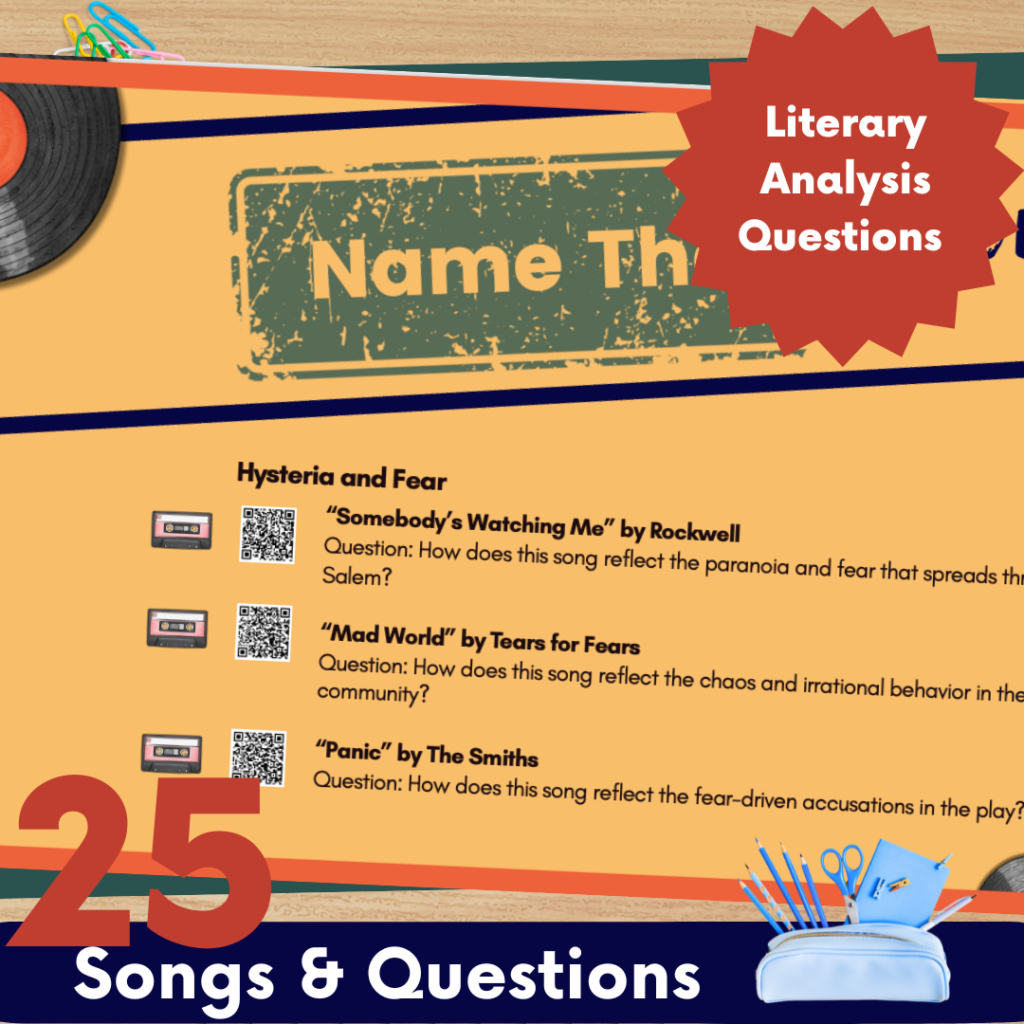
- “Somebody’s Watching Me” by Rockwell – Basically the theme song of Salem.
- “Mad World” by Tears for Fears – Perfect for capturing the chaos of the witch trials.
- “Sympathy for the Devil” by The Rolling Stones – For Abigail’s manipulative moves.
Activity Idea: Divide students into groups and have them create a “soundtrack for the Salem Witch Trials”. They pick the songs and write a short explanation for each choice. Bonus points for spooky cover art!
Bestie Tip: If your students are obsessed with true crime, frame the trials like a crime podcast episode. They’ll eat it up.
3. Huck Finn: Road Trip Vibes and Character Connections 🚣♂️
So, Huck and Jim’s journey down the Mississippi is basically the original road trip story. Use that to your advantage by tying songs to the theme of freedom and friendship.
Huck and Jim’s journey is essentially a road trip story.
Music helps students track emotional shifts across that journey. Character playlists allow students to explore Huck’s internal conflict and Jim’s longing for freedom without forcing it into a formula.
Lyric analysis works well here, especially when students connect one line from a song to a specific moment or decision in the novel.
Quick exit tickets keep it simple and reflective without overcomplicating things.
Tips for Teaching with Music:
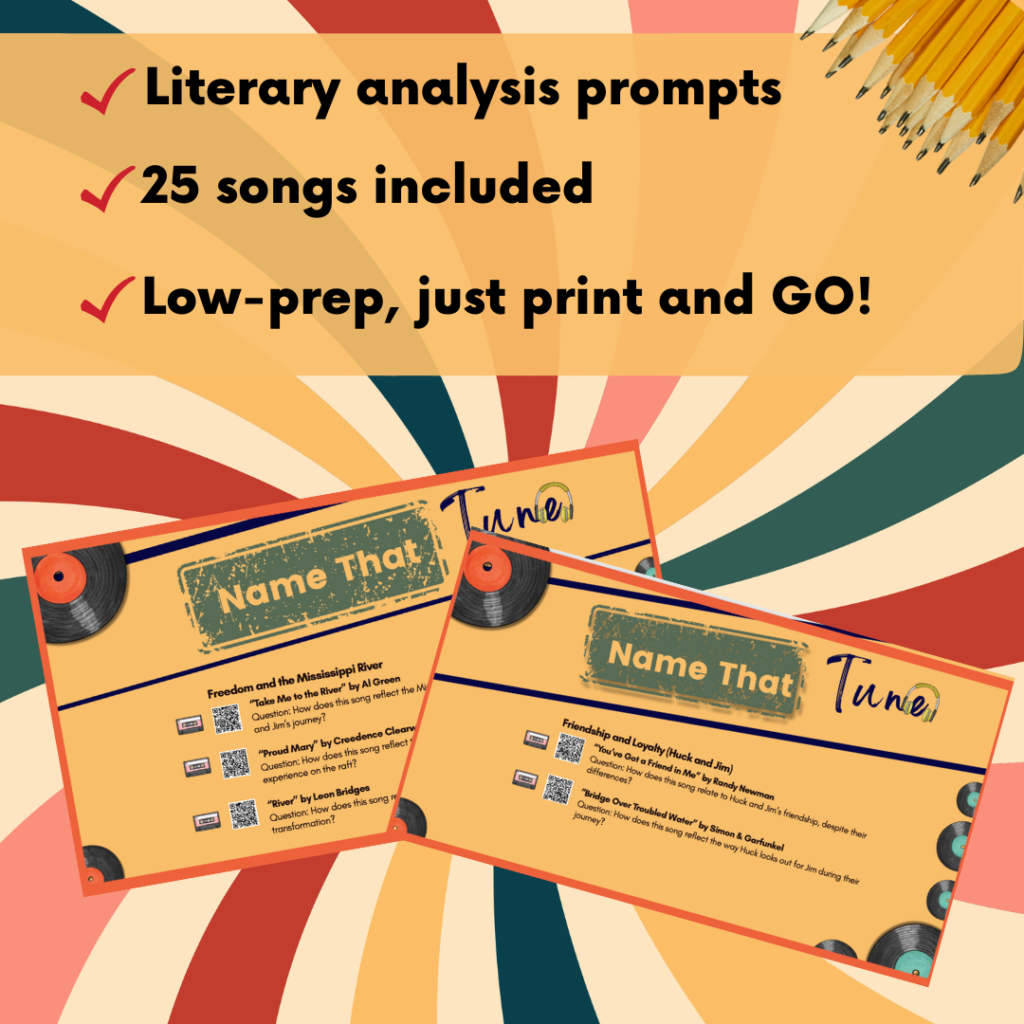
- Character Playlists: Have students pick songs that represent Huck’s struggle with morality or Jim’s longing for freedom. Then, make them explain why each song fits.
- Lyric Analysis: Focus on a key lyric from a song and ask students to connect it to a specific scene or decision in the book.
- Exit Ticket Idea: On their way out, have each student shout out a song that describes Huck’s feelings after a specific chapter. Fast, easy, and keeps them thinking about the text!
Bestie Tip: Play a “mood” song during reading time to capture the book’s vibe—like something adventurous for Huck and Jim’s raft scenes. Trust me, it sets the tone!
4. Fahrenheit 451: Dystopian Beats and Symbolism 🔥
With its themes of censorship and conformity, Fahrenheit 451 is basically begging for a playlist full of moody, dystopian tracks.
Music is especially powerful when teaching dystopian texts.
For Fahrenheit 451, I lean into mood and symbolism. Students choose songs that represent fire, censorship, or rebellion and explain how those symbols evolve over the course of the novel.
Debating which song best represents Montag’s transformation leads to some of the strongest text-based discussions all year.
Instrumental music during reading can also help set tone without distracting from comprehension.
Tips for Using Music to Teach Themes:
- Symbolic Songs: Ask students to find a song that represents the fire or the books themselves as symbols. They’ll love the challenge!
- Debate the Anthem: Have students vote on which song best represents Montag’s rebellion. This gets them arguing (nicely) about themes and symbols.
- Writing Prompt: After listening to a song, ask: “If Montag had a theme song for the moment he decides to rebel, what would it be and why?”
Bestie Tip: Use instrumental music during reading time to set the dystopian mood without distracting lyrics.
5. My Ántonia: Folk Tunes and Nostalgia 🌾
This novel’s all about home, hardship, and nostalgia—so you need songs that feel like warm, dusty afternoons on the prairie.
This novel lives in feeling.
Music helps students understand tone, setting, and emotional distance in ways that traditional worksheets rarely do. Playlists that reflect time period, mood, or memory help students grasp Jim’s perspective and the novel’s reflective nature.
Writing from a character’s point of view using song lyrics as inspiration adds depth without feeling forced.
Tips for Teaching Themes Through Music:
- Time Travel Playlist: Have students find songs that feel like they belong in the novel’s time period. It’s a sneaky way to teach about historical context!
- Compare and Contrast: Play a nostalgic song and a more upbeat one, and ask students which better captures Jim’s feelings about Ántonia.
- Reflective Writing: Have students write a diary entry from Jim’s POV using song lyrics as inspiration.
Bestie Tip: Folksy or acoustic songs work like magic for setting the mood during class reading time.
6. Of Mice and Men: Blues and Broken Dreams 🐭
With themes of friendship, dreams, and isolation, this one’s perfect for a mix of blues, folk, and classic rock.
Music works beautifully for exploring contrast in this text.
Hopeful songs paired with somber ones help students understand the tension between dreams and reality. Character-focused song choices push students to consider perspective and voice, especially for characters who are often overlooked.
Collaborative soundtracks work well here and encourage accountability without killing creativity.
Tips for Using Music to Explore Character and Conflict:
- Dream vs. Reality: Use two songs—one hopeful and one somber—to show the contrast between George and Lennie’s dreams and their reality.
- Character Voice: Have students pick a song for Curley’s wife, Candy, or Crooks to express their perspectives. This gets them thinking about voice and characterization.
- Group Activity: Create a “soundtrack” for the novel with each student submitting one song and a short paragraph explaining their choice.
Bestie Tip: Encourage them to pick a mix of songs—happy, sad, and in-between—to capture all the book’s layers. They’ll be fighting over who gets to add their song first!

Bonus Ideas to Rock Your “Name That Tune” Unit
- Lyric Rewrite Challenge: Have students rewrite a popular song from a character’s POV.
- Song Battle: Pit two songs against each other for each theme and have students vote on which one fits best.
- Soundtrack Review: Have students write a “review” of your playlist explaining which songs fit best and why.
SEO Tip: Phrases like “teaching literature with music” and “literature-based playlists” will help other teachers find your genius ideas.
You’ve Got This!
Teaching classic novels doesn’t have to mean fighting with sleepy students and blank stares. With a killer playlist and some creative activities, you’ll have them making connections to themes, characters, and symbols faster than you can hit “skip.”
So go forth, bestie, and rock that “Name That Tune” unit! Your students won’t know what hit them.
Using music to teach literature is not about being flashy or trendy.
It is about meeting students where they already are and guiding them toward deeper thinking. When students feel connected, they are more willing to analyze. When analysis feels natural, they stop resisting it.
You are not replacing close reading.
You are supporting it.
And sometimes, all it takes is a good song to make the text finally click.
Check Out These Resources from My Fellow Teacher Authors
If you love using music, movement, or creative entry points to help students think more deeply about literature, these posts from fellow teacher-authors are packed with ideas that pair perfectly with a “Name That Tune” approach:
Using Music to Teach Literary Analysis by Bespoke ELA
A thoughtful look at how music can support theme, mood, and character analysis without replacing close reading.Teaching Theme Without Killing the Joy of Reading by Laura Randazzo
Great strategies for helping students understand theme through emotion, connection, and discussion—music fits naturally here.Using Art and Music to Build Literary Analysis Skills by Secondary Sara
A practical guide for blending visual and musical texts to help students access complex ideas in novels.Literary Playlists: A Creative Alternative to Traditional Analysis by Bespoke ELA
Perfect for teachers looking to use playlists, lyrics, and student choice to deepen comprehension and engagement.Engaging Reluctant Readers with Nontraditional Texts by Laura Randazzo
A strong reminder that students often need multiple ways into a text—and music is one of the most powerful.